आइतवार, श्रावण १७ २०८३

A Brief History of Humankind
Introduction
Few books have generated as much international interest over the past few years as Yuval Noah Harari’s Sapiens: A Brief History of Humankind. Originally published in Hebrew in 2011 and translated into dozens of languages, the book has become one of the most widely read popular histories. Harari is a historian at Hebrew University in Jerusalem. In this ambitious history of our own species, he charts out the development of Homo sapiens from its origins as a prehistoric hunter-gatherer to the technologically advanced societies of the twenty-first century. Rather than being like most history books that talk of political history or timelines, it looks at history through the lens of various other disciplines such as anthropology, biology, archaeology, economics, psychology and philosophy. Sapiens tells the story of how we became the dominant species on the planet, out of many.
The central thesis of the book is simple, even provocative. It wasn’t their physical strength or intellectual superiority that made humans successful, Harari writes. It is our unique ability to create and believe fictions, religions, nations, legal systems, money, corporations that allows large numbers of strangers to cooperate successfully. It is the imagined reality, Harari argues, that makes humans different from other species and have determined every phase of civilization. In this the author invites the reader to question many social institutions that are often taken for granted or assumed to be permanent.
The book was formed by four historical revolutions: the Cognitive Revolution, the Agricultural Revolution, the Unification of Humankind and the Scientific Revolution. Instead of treating these as isolated revolutions in history, Harari shows how each revolutionized human society and paved the way for the next stage of development. This clear organizational structure allows readers to follow thousands of years of history without becoming overwhelmed by historical detail.
One of the most amazing things about Sapiens is how Harari takes complex ideas and makes them available to a broad audience. The book makes scientific theories, archaeological discoveries and philosophical arguments clear and engaging, without losing intellectual depth. Harari’s examples from everyday life are familiar, which enables the readers to connect historical developments to present-day challenges such as globalization, capitalism, artificial intelligence, environmental degradation and technological innovation. The book will thus be of interest not only to historians but also to those interested in economics, sociology, education, political science and environmental studies.
The other defining feature of the book is its readiness to question received assumptions about history. Harari challenges the old assumption that every step forward in human progress necessarily increased human welfare. For example, he argues that the Agricultural Revolution resulted in increased food production, but also in social inequality, disease and more demanding work patterns. These sorts of arguments lead the reader to develop a critical rather than a passive attitude to historical developments, to the standard narratives of progress. Whether or not you agree with these interpretations, the book succeeds in stimulating intellectual curiosity and discussion.
One of the reasons for Sapiens’ popularity is its relevance to contemporary issues. Harari does not merely recount history. He continues by making links between past revolutions and the problems of today’s world. His treatment of consumerism, biotechnology, digital technology, climate change and artificial intelligence encourages us to reflect on our past and future. In that sense, Sapiens is a history book, a philosophical meditation, a commentary on modern civilization. All in one.
The review touches upon the main points of Harari, pros and cons of his interdisciplinary approach, and the educational value of the book. Sapiens has been praised for its ability to challenge our assumptions about history, while providing helpful insights into the social, cultural, and technological forces that continue to shape the modern world.
Critical Discussion
First, Harari discusses the Cognitive Revolution, which he claims was the most important event that set Homo sapiens apart from all other human species. The author says that some 70,000 years ago, humans gained the ability to use complex language, symbolic thought and imagination. Other animals talk about food or danger when it is right there . We learned how to speak about abstract ideas and imaginary realities. According to Harari this special ability enabled large numbers of unrelated people to co-operate around shared beliefs, myths, customs and institutions. Nations. Religions. Laws. Corporations. Even money. All things that are, because man believes in them. This is the main argument of the book and a new explanation for mankind’s phenomenal success.
Harari's idea is delivered in an interesting and accessible way. He does not use a lot of technical language but uses examples that are common in our daily life to explain abstract concepts. We ask our readers to consider that much of what rules modern society is social construction, not objective facts. The reading manages to relate the evolution of prehistoric times to the current political and economic systems. That makes the discussion relevant to the readers today. But some anthropologists have argued that the exact reasons for the Cognitive Revolution are unknown, and that Harari sometimes reads speculation with more certainty than the archaeological record allows.
The second big change, the Agricultural Revolution, is one of the most controversial arguments of the book. Agriculture is traditionally hailed as humanity’s greatest achievement, but for Harari it is ‘history’s biggest fraud’. What he says is that farming made more food and more people but also made people less healthy. Harari states that early farmers were dominated by the toil of heavy labor and seasonal farming and had a worse diet, less spare time and were less physically active than hunter-gatherers.
Food production is only one of the broader social consequences of agriculture that Harari describes. Permanent settlements introduced private property, social stratification, organized religion, taxation and political power. Some people were able to amass wealth and power, having surplus food. Others became agricultural laborers and inequality grew. This reading questions the assumption that technological advancement is intrinsically a sign of human progress. Many historians find Harari's conclusions deliberately provocative, but they do open a serious discussion about the relationship between economic development and human welfare.
The Unification of Humankind is the third section and follows the slow integration of disparate societies through trade, empires, religion and money. Harari says that despite the great diversity of cultures, human civilization has been slowly moving towards more interconnectedness. “Money is one of the most successful inventions of history,” he says. “It allows strangers to work together regardless of nationality, language or religion. Money, gold, paper money, or digital transactions functions because people all buy into its value.
Harari also looks at the historical role of empires and universal religions. He admits the violence was a part of imperial expansion, but also claims that empires enabled cultural exchange, technological diffusion, legal systems, and economic integration. For example, Buddhism, Christianity and Islam created common moral codes which united people of different backgrounds. Harari does not portray these institutions as entirely good or bad but as historical devices that enabled ever more complicated forms of social cooperation.
The most interesting bit of the book, perhaps, is Harari’s discussion of the Scientific Revolution. What made the Scientific Revolution different from previous periods of history was that it arose from a willingness to acknowledge ignorance, and to study nature by means of observation and experiment. But for Harari, the scientific revolution transformed the human relationship to knowledge, substituting empirical inquiry for unquestioned authority. This revolution of the mind brought about extraordinary advances in medicine, transportation, communications, engineering, and industry.
One key contribution of this section is Harari’s account of the relation between science, capitalism and political power. He argues that scientific research is seldom conducted in isolation but is tightly bound to economic investment and governmental interests. Capitalism drives innovation because investors expect future discoveries that will spur economic growth. This combination of science and economics explains most of the features of today’s global world which include industrialization, globalization and technological influence.
This discussion is particularly pertinent considering Harari's belief in recent developments in biotechnology and artificial intelligence. He argues that we may be on the cusp of another revolution in which technological innovation alters human identity itself. Recent advances in genetic engineering, machine learning and digital technologies bring important ethical questions about equality, privacy, education and the future of work. These discussions are not confined to the conventional historical investigation, but they do point to the possibility of the past informing present day global problems.
One of the strengths of Sapiens is Harari’s interdisciplinary approach. He weaves together anthropology, biology, economics, psychology, sociology, and philosophy, creating a broad narrative that will appeal to readers from many areas of scholarship. The ability to link prehistoric developments to contemporary technological problems is particularly impressive. This explains the popularity of the book among university students as well as the public.
But the range of the book also means some limitations. To condense some 70,000 years of history into one volume requires considerable simplification. Some debates in history are not well covered and alternative interpretations by scholars are sometimes disregarded. Harari has also been criticized by commentators for tending to prefer a good story to historical complexity. However, these limitations do not undermine the book’s overall contribution. Instead, they suggest that readers should look elsewhere and think critically about the arguments presented.
In conclusion, the four historic revolutions provide a coherent framework for Harari’s explanation of the development of modern civilization. At every turn the author demonstrates that human history is as much about shared ideas and collective imagination as it is about biological evolution or technological innovation, from prehistoric cognition to agricultural societies, to global empires, to artificial intelligence. This key insight makes Sapiens both intellectually stimulating and highly relevant to the current discussions about society, education and future of humanity.
Strengths
One of the great strengths of Sapiens is Harari’s amazing ability to turn complex academic debates into an entertaining and accessible story. The book deals with a vast time span of some 70.000 years of man’s history, but the structure is always similar, which enables the reader to understand the interrelations between biological evolution, development of culture, economic systems and scientific progress. The author’s interdisciplinary approach manages to cross the border between history, anthropology, archaeology, sociology, psychology, economics and philosophy. This makes the book interesting for readers with different academic backgrounds.
It is worth mentioning the style of Harari’s writing. His writing is lucid, terse and provocative. He steers clear of needless technical jargon, whilst being intellectually stimulating. At the conclusion of each chapter are questions to stimulate critical reflection on accepted assumptions about civilization, progress, religion, capitalism and technology. Instead of teaching history as a series of dates and events, Harari teaches how the expansion of history is relevant to present political, economic and social realities. One of the book’s great accomplishments is its linking of the distant past to present-day global problems.
Another important contribution is the idea of imagined realities. Harari argues strongly that institutions like nations, legal systems, corporations, religions and money exist because people collectively believe in them.
Sapiens has its limitations, despite its strengths. The scope of the book necessarily implies simplification of complex historical processes. Harari has drawn criticism from some scholars for presenting speculation as fact, particularly regarding prehistoric societies and human cognition. Critics have argued that his treatment of agriculture, religion, and capitalism at times highlights negative outcomes while ignoring alternative insights or positive historical developments. In general, these criticisms are well-founded; but they should be regarded as invitations for further scholarly debate, rather than as defects that detract from the general worth of the book.
Therefore, academically speaking, Sapiens must be read as an interpretation, and not as the final history of humanity. Harari isn’t trying to summarize historical evidence, but to make readers think about the assumptions we’ve long held about civilization and progress of the human species. The book does a very good job here.
Educational Impact
Sapiens is educational not only in the field of history. The book is a good example of interdisciplinary scholarship, demonstrating how knowledge from different academic disciplines can be synthesized to explain complex social phenomena. Harari’s book is a valuable resource for university students, researchers and educators to link historical progress to present day discussions on globalization, environmental sustainability, artificial intelligence, biotechnology and digital society.
The book draws attention to the importance of critical thinking and inquiry-based learning for students in education. Harari asks them to weigh evidence, compare interpretations and draw their own conclusions. This approach is compatible with current pedagogical philosophies of analytical thinking, creativity and the lifelong process of learning.
The last chapters will be of special interest to researchers in educational technology. Harari’s treatment of information, communication, artificial intelligence and technological change raises significant questions about the future of teaching, learning and knowledge production. Digital technologies help to reshape educational phenomena from chalk to clicks around the world. This book sapiens provides crucial historical context for understanding the belief of the change.
Conclusion
Sapiens: A Brief History of Humankind is an ambitious, provocative and intellectually stimulating survey of the history of humankind. Yuval Noah Harari combines a multi-disciplinary approach to describe how Homo sapiens evolved from small bands of hunter-gatherers to dominate the planet. His focus on imagination, cooperation and shared beliefs offers readers a fresh look at the origins of civilization and the institutions that govern modern society.
Some interpretations are controversial, and have been the subject of academic debate, but the greatest strength of the book is its power to make readers think critically about the past, present and future of humanity. Its accessibility of style, interdisciplinary outlook and contemporary relevance make it an excellent resource for students, teachers, researchers and general readers.
In sum, Sapiens does not disappoint concerning its international reputation as one of the most influential popular history works of recent decades. I highly recommend this to anyone interested in learning more about the forces that have shaped human civilization, and the challenges that may shape its future.
References
Harari, Y. N. (2015). Sapiens: A Brief History of Humankind. Harper.
Harari, Y. N. (2017). Homo Deus: A Brief History of Tomorrow. “Harper.
Harari, Y. N. (2018). 21 lessons for the 21st century. New York: Spiegel & Grau.
Wilson, E. O. 2012. Social conquest of the world. Liveright.
Chrisomalis, S. 2010. Numerical Notation. A comparative history. Cambridge University
Press.
Claessen, H.J.M., and Skalnik, P. 1978. The Early State. The Hague: Mouton.
Diamond, J. 1997. Guns, Germs and Steel. London: Vintage.
Everett, D. 2008. Don't Sleep, There Are Snakes. Life and language in the Amazonian
Jungle. London: Profile Books
Hallpike, C.R. 1979. The Foundations of Primitive Thought. Oxford: Clarendon Press.
Hallpike, C.R. 1986. The Principles of Social Evolution. Oxford: Clarendon Press.
Hallpike, C.R. 2008. How We Got Here. From bows and arrows to the space age.
Bloomington, Indiana: Author House.
Hallpike, C.R. 2016. Ethical Thought in Increasingly Complex Societies. Social structure and
moral development. New York & London: Lexington Books.
About the Reviewer
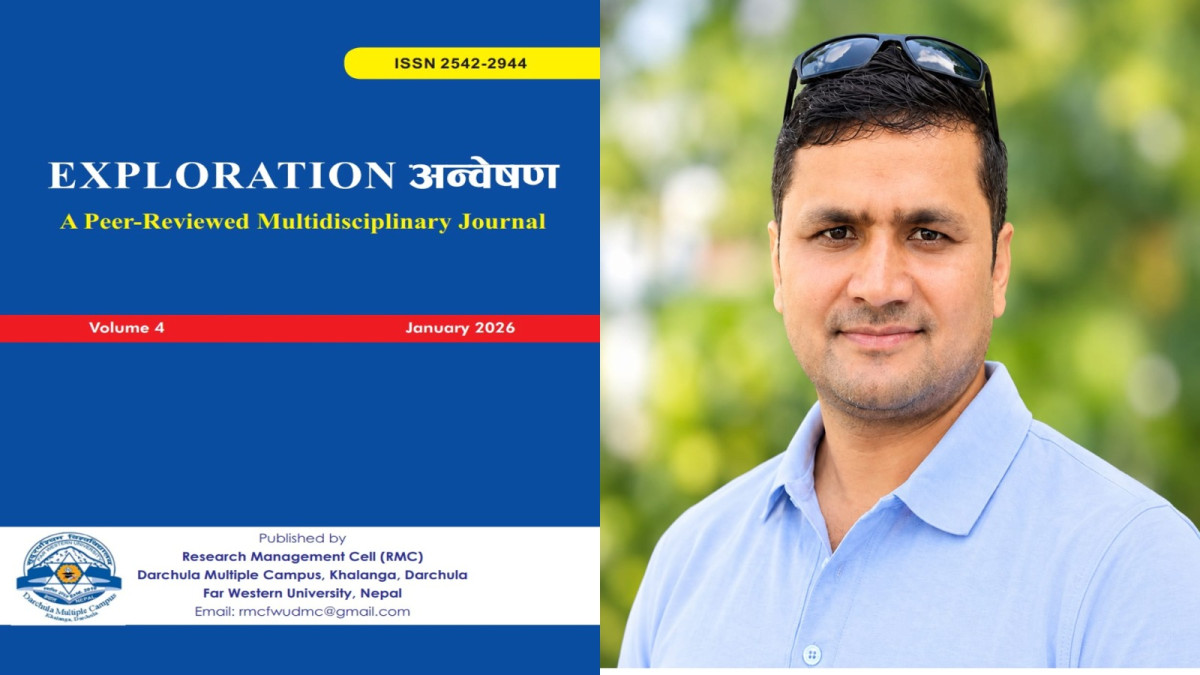
Jeevan Regmi is an MPhil Scholar in English Language Education, Kathmandu University School of Education, Nepal. His research interests include educational technology, digital pedagogy, teacher professional development, language policy and interdisciplinary approaches to English language education. As the principal of government level secondary school at very young age, he is studying the use of technology in community schools in Nepal and new ways to teach and learn languages.
A Book Review of
Yuval Noah Harari
Harvill Secker, 2014, 443 pp., £9.99
ISBN: 9780099590088

.png)